John Colton, the Homesteader Who Founded a Town

The Homestead Acts passed in the second half of the 19th century opened up public land for settlers who were willing to live on and farm it. From these homesteaders, new towns and businesses were formed. However, the livelihood of these communities were dependent on outside forces, particularly that of the railroad industry.
In 1862, Congress passed the Homestead Act, a piece of legislation that opened up large swathes of public land and made up to 160 acres of land available for the price of a small filing fee to anyone who was willing to live on and work it. As long as an individual lived and farmed there for a certain amount of time (five years at first, then later three years), they would be able to “prove up” their claim and receive legal title to the land. Overall, around 1.6 million people successfully proved up their homesteads. John E. Colton was one of these homesteaders. He arrived in what would soon be known as South Dakota in 1878, and acquired the maximum 160 acres of land.
The first Homestead Act was not the last. Throughout the late 19th century and early 20th century, several acts were passed that added to or altered the original act. One such act, coming many years after John Colton’s homesteading days, was the 1909 Enlarged Homestead Act, which raised the maximum amount of acres that could be homesteaded. Another act was the Timber Culture Act, passed in 1873. The Timber Culture Act allowed homesteaders to acquire up to 160 acres of land as long as 40 acres were planted with trees. This act allowed John Colton to obtain another 160 acres of land to add to his farm.
The various homestead acts were not the only way that an aspiring homesteader could acquire land. If one had the money, land could be bought. This is how John Colton added another 160 acres to his farm, bringing the total size of his farm up to 480 acres. The additions showed that quarter section of land as envisioned in the original law was insufficient to meet the needs of farmers in the more arid Great Plains.
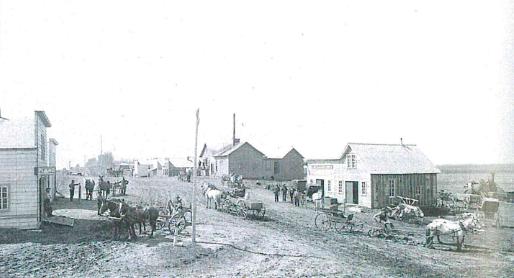
John Colton became quite the successful farmer. An Argus Leader newspaper article from 1894 specifically mentions him raising sheep for wool. In 1897, he opened Taopi Creamery with some other farmers. Taopi Creamery got its name from the nearby township of Taopi. Taopi Township was named for the town of Taopi in Minnesota which was where the township’s founder J. B. Goddard was from. The creation of the creamery soon drew in other businesses, including a buttermaker, a blacksmith, a couple of general stores, and a post office. In 1899, John and his wife Paulina platted part of their farm into town blocks, marking the formation of the town of Colton.
Despite the modest business boom in Colton, John Colton knew that the new town would not survive without access to a railroad. Not only would a railroad allow Colton’s population to rapidly grow, it would also be incredibly useful to Colton’s growing business district. Railroads provided access to dry goods and materials that were incredibly useful to growing business and homesteads. It also allowed businesses to ship out their goods to other regions, thus increasing their ability to profit.
With the help of Paul F. Sherman, John Colton began courting railroad companies, trying to convince them to build rails near Colton. One thing to note is that John Colton had been a staunch supporter of the Populist Party since 1891, before the creation of Colton. An important tenant of the Populists was a dislike of railroad companies that cheated farmers by setting unfair freight rates. Despite his political beliefs, John Colton was able to see the importance of gaining a railroad in Colton. Through the selling of land to businesses, he was able to raise enough money to get the South Dakota Central Railroad to build through Colton in 1904, thus securing the future of Colton.
Images